How Bonfire Season Became Pogrom Season
Loyalist bonfire season used to be about harassing and attacking our northern brethren, burning tricoulours and papal effigies. Now, it is an annual carnival of orchestrated racist violence. Interestingly, it has in its own twisted way embraced an inverse multiculturalism.
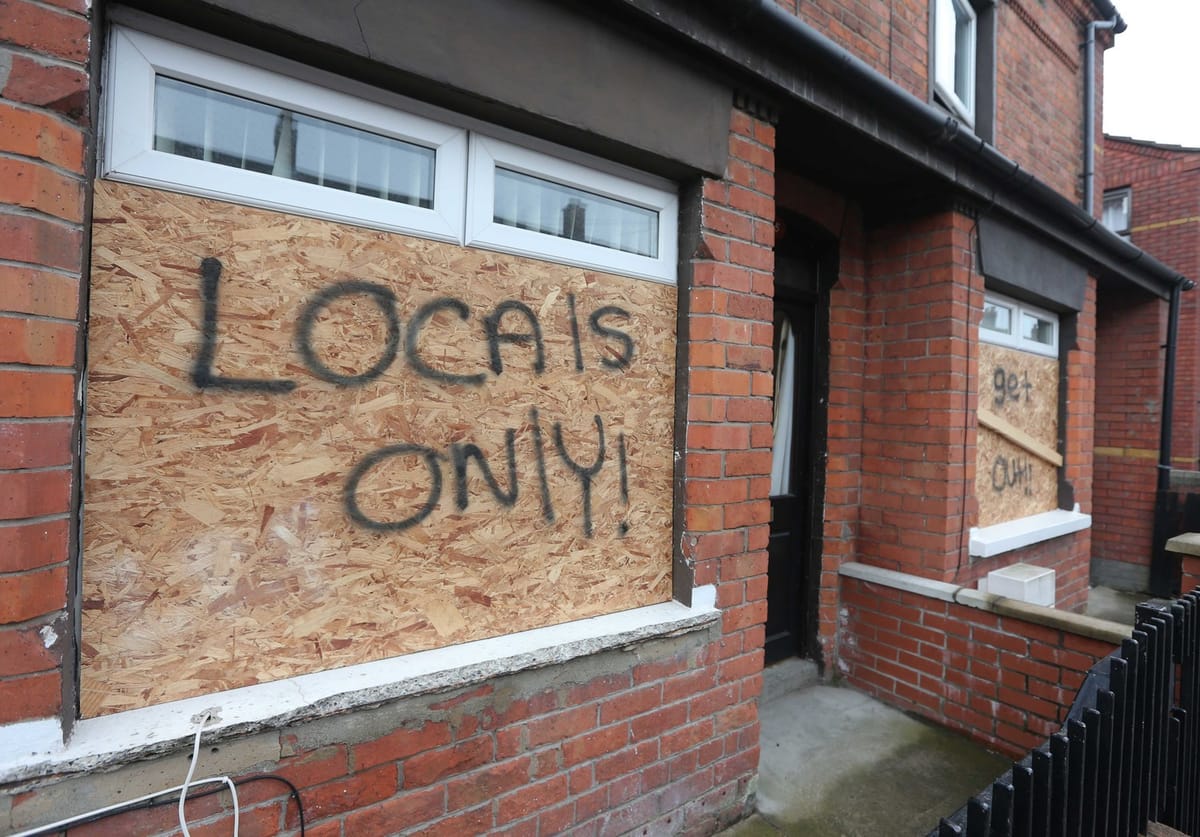
In one corner, the perpetrators of hateful violence, you have the loyalist extremists, street thugs, west brit traitors, gombeens and behind them an international fraternity of white supremacy from Israel to Idaho.
In the other corner, being faced with the former, immigrants, republicans, the broader left and everyone else.
We must first unequivocally condemn the horrific attack that sparked all this. Regardless of colour or nationality, questions need to be answered about how someone capable of that horrific act was walking the streets. An attack like that did not materialise out of the mist. The perpetrator should have been in a mental hospital at the very least a long time ago. Please god, justice will be done, because the victim, a radiographer for the NHS mind, has had life altering, career ending injuries if he survives at all. He is in a critical condition, with one eye gouged out completely, the other partly and likely blinded as well as severe injuries to his face, back and arms. He would be dead if it was not for the passerby with the hurley.
This has absolutely nothing to do with others who may be the same colour, nationality or immigration status as the perpetrator, however.
For generations in the occupied 6 counties, the coming of July has meant one thing: marching season. Hundreds of bonfires, towering pallet infernos built on loyalist estates keeping every logistics night watchman awake since early May, are set alight on the Eleventh Night to celebrate the Twelfth of July. Marking the first time (but not the last) they followed a foreign, Camp-closeted conservative into battle for arbitrary, nonsensical, religious and political reasons. The first of many, and about the only time they won. For many families who are not from Protestant, loyalist backgrounds, this has always been a time of tension. Catholic families have long taken their summer holidays to avoid the flashpoints and sectarian abuse.
But something has changed. The pogroms of 2024, 2025 and now 2026 have written a new itinerary into this calendar. What was once largely, post-peace process anyway, sectarian intimidation has become something far more organised: an explicitly racist, anti-immigrant purge, timed with military precision to coincide with the summer parades.
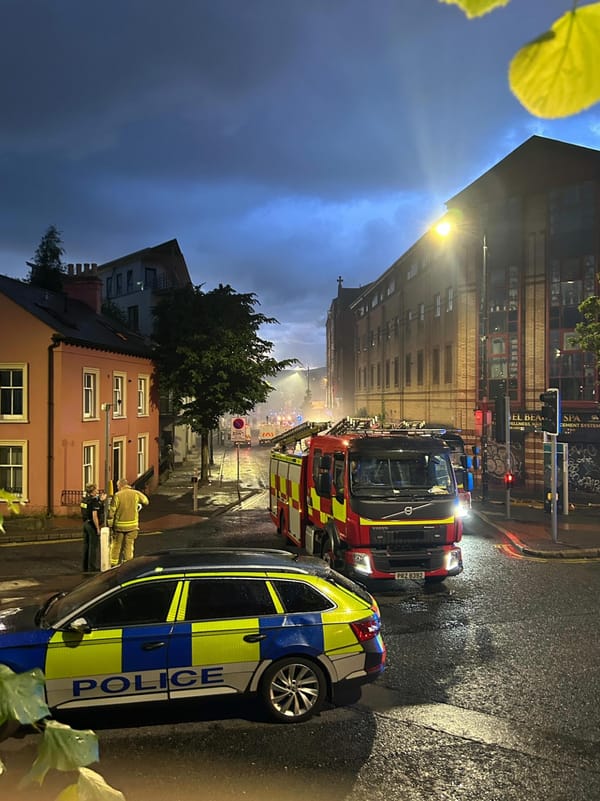
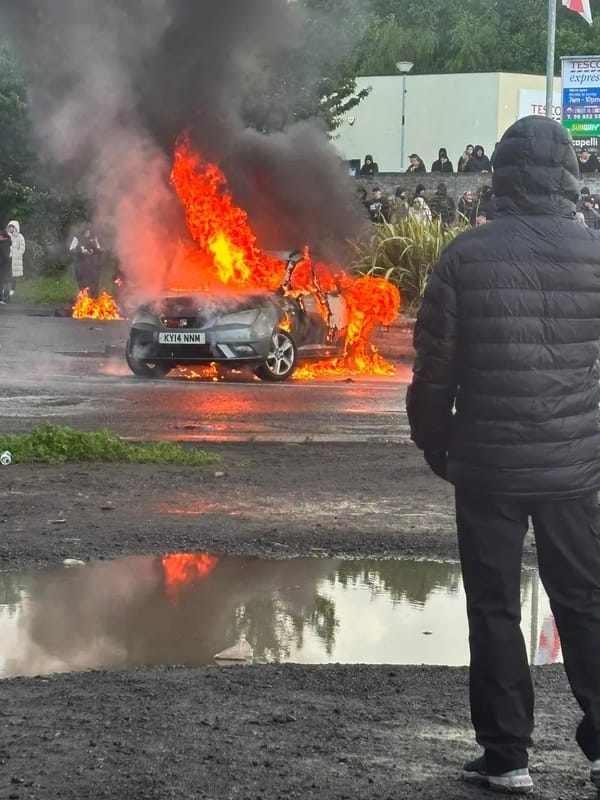
The data proves this is no longer a coincidence. In August 2024, racist riots erupted in Belfast. Just months later, June 2025 saw the second-highest monthly total of race incidents ever recorded, driven by days of orchestrated rioting in Ballymena that saw homes torched and families fleeing for their lives. Ballymena was the “springboard”. June 2026 then followed the exact same itinerary: a horrific attack, a viral video, and suddenly hundreds of masked men were burning vehicles and forcing terrified immigrants from their homes in the dead of night. Followed by, in spite of their “we are all in this together” to our gombeen right, attacks on Catholic homes and vehicles.
The main event in this backward display that would be banned anywhere else in Europe if the targets were anyone else but us and refugees: The Eleventh Night bonfire. At Moygashel, County Tyrone, builders hoisted a boat containing more than a dozen life-sized mannequins of Black migrants wearing life jackets to the top of the pyre. A banner reading “stop the boats” was hung below. As the flames rose, women photographed their children in front of the burning effigies, calling this simulated lynching “brilliant”. The following year, the same site saw tyres and toxic materials investigated by the environmental crime unit, proving Stormont cares more about air pollution than hate crime any day of the week.
Calling it a “pogrom” is not hyperbole. A major report on the Ballymena violence was titled “Inciting a Pogrom?”. The term has been used by MPs to describe the targeting of immigrants. Thousands of minority residents, particularly Roma families, were displaced as a direct result of the 2025 summer violence. Migrant communities have resorted to stockpiling food, terrified of another summer of unrest. Amnesty International called the past year a “shameful year of racist violence”, noting that racism in the north has gotten “out of control”.
Just as Thanksgiving marks the start of the Christmas shopping season in the United States, the approach of July in the north is now marked with a pogrom. It is predictable. It is systematic. And it is treated, by a shamefully passive state, as an inevitability rather than something to be cracked down on before it starts.
The parallel is not lost to us, that a holiday, either side of the Atlantic that commemorates colonialism and the subjugation of the native people, marks 2 different halves of the year either side of the Atlantic, or that the same people were behind both, or that today, the same international right-wing oligarchs profit from both, monetarily from the American side, politically from both.